

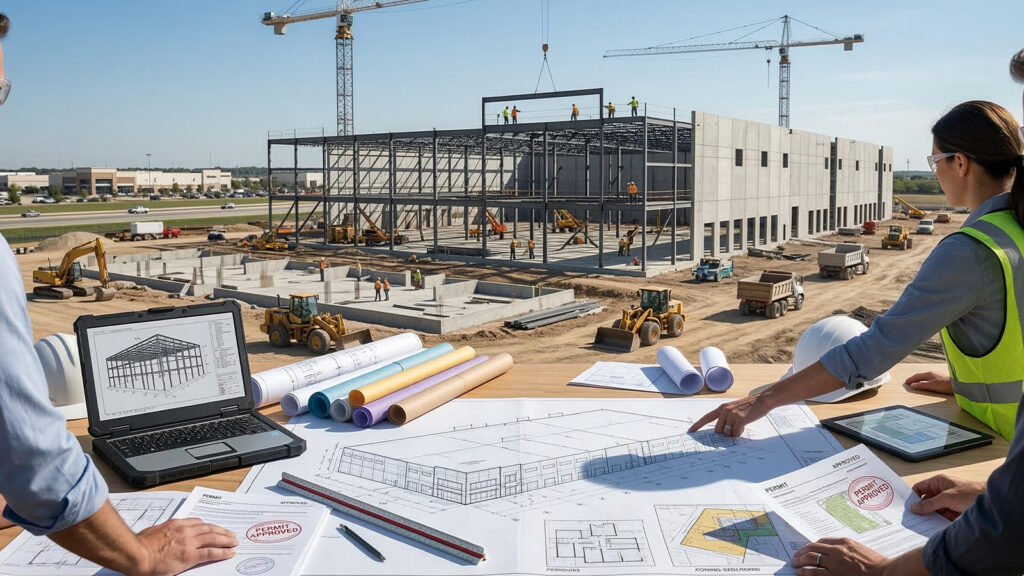
Commercial development in Texas moves fast, but the regulatory framework surrounding it demands careful preparation. Whether planning new construction for an industrial facility or a renovation of an existing commercial space, understanding the permit process from the start is essential. All commercial projects require building permits before work begins, and specific construction requirements vary significantly by city or county across the state.
Texas commercial construction operates within a layered system of state regulations and local amendments that can look very different from Fort Worth to a smaller west Texas jurisdiction. That gap directly affects project timelines, construction costs, and budget in ways that catch unprepared owners off guard. This guide breaks down the regulatory considerations every owner and developer should understand before breaking ground.
Key Takeaways
- Obtaining permits is the first legal step in any Texas commercial project—requirements vary by city or county and must be confirmed before design is finalized.
- Zoning regulations and land use approvals must be secured before a commercial building permit can be issued.
- Local amendments to the International Building Code affect fire protection systems, occupancy classifications, and energy efficiency standards across texas.
- MEP systems—mechanical, electrical, and plumbing—must pass inspection at designated phases before the next stage of building construction can proceed.
- Early planning, including a pre-application meeting with the local building department, is the most effective way to identify potential issues early and protect project timelines.
- Staying informed about local regulations and code updates reduces the risk of change orders, costly delays, and budget overruns.
Introduction
Commercial construction in Texas operates within one of the most dynamic business environments in the country. Texas cities adopt model codes published by the International Code Council—including the International Building Code and the International Energy Conservation Code (IECC)—but local amendments modify those standards in ways that vary significantly by jurisdiction. What applies in one market may not apply in another, and the gap between state regulations and local requirements can be substantial.
The permitting process is not a formality—it is the mechanism through which jurisdictions verify that building plans meet safety regulations, life safety standards, and energy efficiency requirements before construction begins. MBC Management’s General Contracting services are built to manage this process efficiently, coordinating with local permitting authorities and ensuring that design and engineering outputs meet each jurisdiction’s standards.
Understanding Texas Commercial Permit Requirements
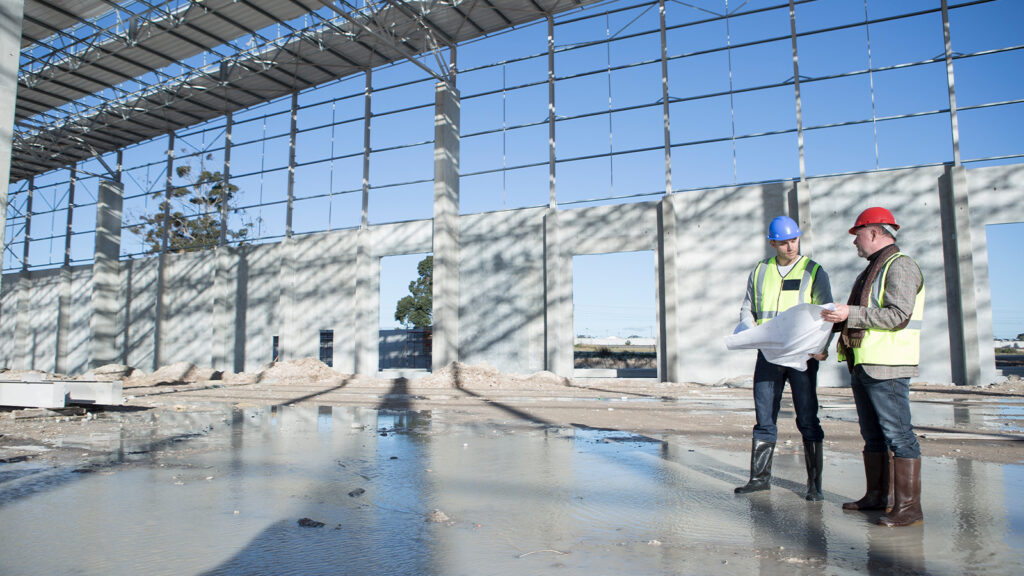
Navigating texas commercial construction begins with its two-layer regulatory structure. State regulations set minimum standards, while local amendments—adopted by each city or county—layer on jurisdiction-specific requirements that affect building plans, design and construction decisions, and approval timelines.
Building Codes and Local Amendments
The International Building Code and the IECC serve as base building codes for Texas commercial projects, but local amendments adopted by individual jurisdictions can significantly alter requirements for fire suppression systems, HVAC efficiency, egress design, and occupancy classifications. Contractors and subcontractors must verify compliance with the specific code edition and local amendments in effect at the project site—before building plans are finalized. Discovering a conflicting local amendment during plan reviews adds cost and delay that could have been avoided with requirements early engagement.
Zoning Regulations, Land Use Approvals, and the Local Building Department
Before a commercial building permit can be issued, the project must clear zoning regulations and secure the necessary land use approvals. Zoning determines whether the target parcel supports the intended commercial development—confirming the zone classification and use approval before committing to design costs is non-negotiable. In many Texas jurisdictions, zoning review runs through public works or a separate planning division, parallel to but distinct from the building permit track.
Texas requires direct engagement with the local building department early in the project lifecycle. A pre-application meeting allows the team to confirm local requirements, flag any outstanding land use approvals, and review utility connection fees before substantial design investment has been made—addressing requirements early rather than discovering them at submission.

Plan Reviews, Approval Timelines, and Local Permitting
The Code Review and Approval Process
Once building plans are submitted, the local building department initiates a formal code review. Plans for code compliance are evaluated across structural, mechanical, electrical, and plumbing disciplines before a commercial building permit can be issued. For complex commercial facilities, plan reviews may involve multiple comment rounds—each requiring revised drawings or written justification from the design team.
Setting realistic timelines for this phase protects the overall project schedule. A straightforward commercial permit application in a smaller jurisdiction may clear in two to four weeks. A new commercial facility in a major urban market can require 60–120 days or more. Local permitting processes should be accounted for in early planning—not treated as a formality. General contractors with established local expertise and familiarity with local requirements are the most reliable resource for navigating commercial permit timelines efficiently.
Technical Construction Requirements Across Texas
MEP Systems, HVAC, and Code Compliance
Mechanical, electrical, and plumbing (MEP systems) work represents a significant portion of the code compliance burden on any commercial project. Texas commercial buildings must meet HVAC efficiency standards established by the IECC—HVAC efficiency requirements may reference ASHRAE 90.1 depending on local amendments—and all plumbing must plumb to the applicable code. MEP systems must pass inspection at designated rough-in phases, and final documentation must reflect compliance with approved plans in the as-built record.
Life Safety, Fire Protection Systems, and ADA Requirements
Life safety requirements for Texas commercial facilities are driven by occupancy classification. Higher-occupancy uses—assembly, educational, healthcare—trigger more stringent requirements for egress width, emergency lighting, and fire protection systems. Fire suppression systems must be submitted as part of the commercial permit package and are subject to a separate inspection track managed by the authority having jurisdiction.
The Americans with Disabilities Act and Texas Accessibility Standards impose accessibility obligations throughout a commercial building. Texas requires accessibility plan review through the Texas Department of Licensing and Regulation for most commercial projects above a threshold size. Incorporating ADA requirements into the original building plans—rather than retrofitting after design is complete—is the most cost-effective approach. MBC Management’s design and engineering process treats accessibility review and ensure compliance as a standard step in every commercial project.
| Discipline | Governing Standard | Key Requirements | Inspection Phase |
| Structural | IBC / Local Amendments | Foundation, framing, load capacity | Foundation, framing rough-in |
| HVAC | IECC / ASHRAE 90.1 | HVAC efficiency, duct sealing, ventilation | Rough-in, final |
| Electrical & Plumbing | NEC / State Plumbing Code | Wiring, fixtures, venting, backflow prevention | Rough-in, final |
| Fire Protection | IBC / NFPA | Fire suppression systems, egress, life safety | Hydrostatic test, final |
| Accessibility | ADA / Texas Accessibility Standards | Routes, restrooms, parking, service counters | Plan review, final |
Inspections, Final Inspections, and Obtaining the Certificate of Occupancy
The inspection process for commercial building construction runs throughout the project. Texas regulations require inspections at foundation, rough-in MEP, insulation, and final inspections stages—each must pass before work in that phase is covered or enclosed. Missed windows require rescheduling and compress the construction schedule when contractors and subcontractors are already deployed on site.
Final inspections verify compliance across all disciplines. Upon their successful completion, the jurisdiction issues a certificate of occupancy—the legal prerequisite for any business to occupy and operate from the commercial space. Obtaining permits also carries direct costs: permit fees are typically based on project valuation, and utility connection fees, plan review fees, and inspection charges all contribute to total project costs. Change orders driven by code issues caught during code review—rather than at the pre-application stage—are among the most preventable sources of budget overrun. A thorough internal code review before submission, and engagement with general contractors who have established local expertise, is the most effective way to verify compliance with all applicable texas regulations.
Conclusion
Navigating commercial construction regulations in Texas requires more than a checklist. It requires local expertise, early engagement with the relevant jurisdictions, and a construction team that understands how to move efficiently through the commercial permit process. Texas regulations are not uniform across texas cities, and treating them as such produces costly delays, unexpected construction costs, and avoidable friction with the local building department.
Whether your commercial projects involve new commercial warehouse development, industrial renovation, or complex design-build facilities across the Houston corridor or Central Texas, MBC Management brings the regulatory knowledge and contractor relationships to keep your project compliant and on schedule. Contact MBC Management today to discuss your next commercial construction project.
Frequently Asked Questions
What is a commercial building permit in Texas?
A commercial building permit is the official authorization issued by a local building department confirming that submitted building plans have passed code review and meet applicable state and local standards. Building permits are required before commercial construction can legally begin in Texas. A permit cannot be issued until plan reviews are complete and any required zoning and land use approvals are in place.
What building codes apply to commercial construction in Texas?
Texas commercial construction is governed by the International Building Code, the International Energy Conservation Code (IECC), and the National Electrical Code, along with Texas Accessibility Standards administered by the Texas Department of Licensing and Regulation. Individual cities and counties apply local amendments to these base codes, so specific requirements depend on the project’s location and jurisdiction.
How long does it take to get a commercial permit in Texas?
Commercial permit timelines vary by scope and jurisdiction. Smaller markets may complete plan reviews in two to four weeks. Major urban markets can require 60–120 days or more for complex commercial facilities, particularly when zoning review must run concurrently with the building permit application. Early planning is the most reliable way to protect overall project timelines.
What inspections are required for a commercial building in Texas?
Required inspections typically include foundation, structural framing, rough-in MEP systems, insulation, fire protection systems, and final inspections. Fire suppression systems require a separate inspection track. Each phase must pass before the next phase is covered or enclosed. Final inspections must be completed and passed before a certificate of occupancy can be issued.
How do ADA requirements apply to commercial construction in Texas?
The Americans with Disabilities Act and Texas Accessibility Standards require commercial buildings to provide accessible parking, entrances, restrooms, and interior pathways meeting specific dimensional standards. Texas requires accessibility plan review through the Texas Department of Licensing and Regulation for projects above certain size thresholds, in addition to the standard local building permit review process.
What are the most common causes of costly delays in the Texas commercial permit process?
The most frequent causes are design errors caught during code review rather than at the pre-application stage, failure to secure zoning regulations and land use approvals before permit submission, and missed inspection windows during active construction. Engaging contractors with local expertise, conducting a thorough internal code review, and holding a pre-application meeting with the local building department are the most effective ways to avoid these issues.