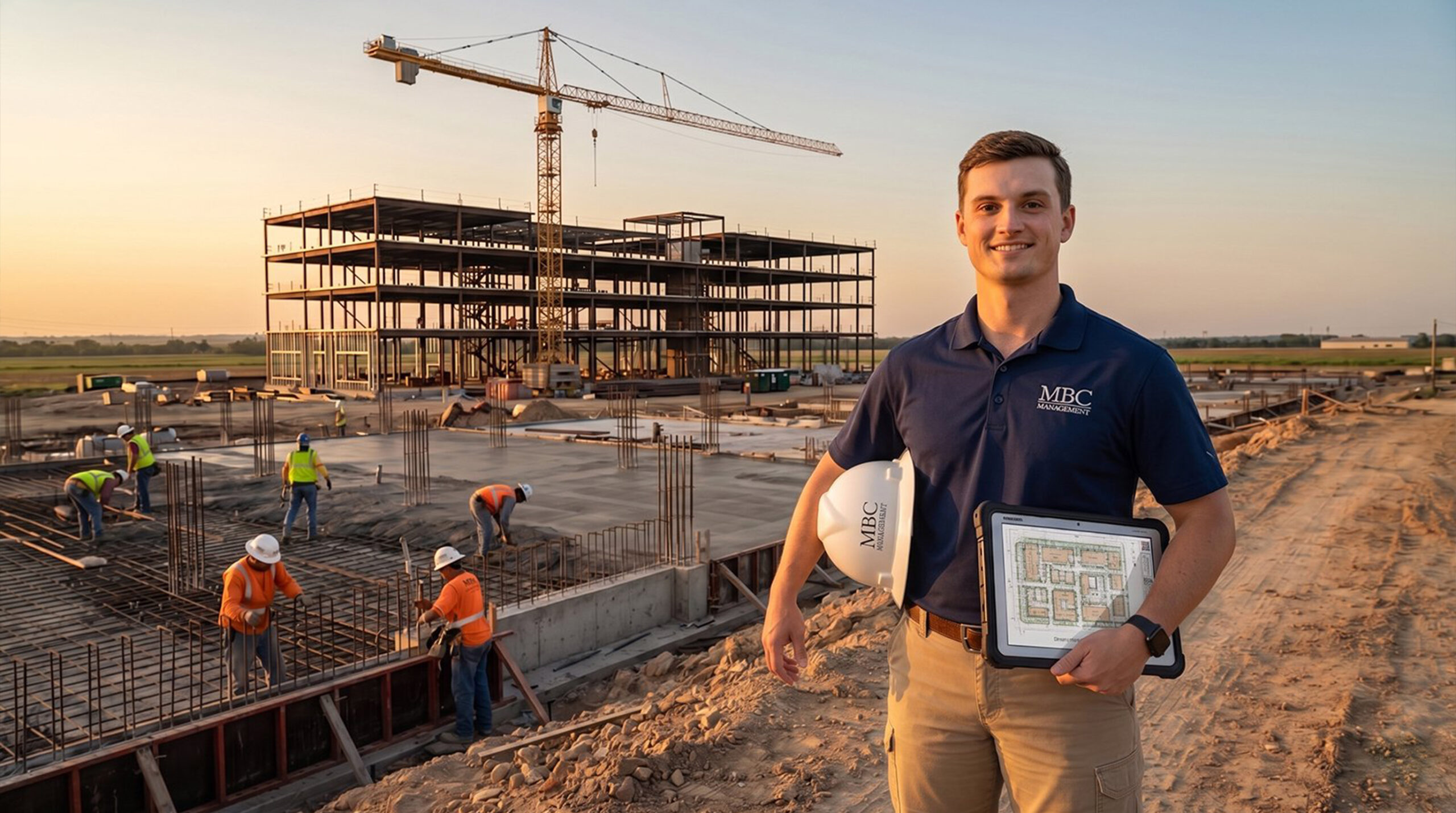
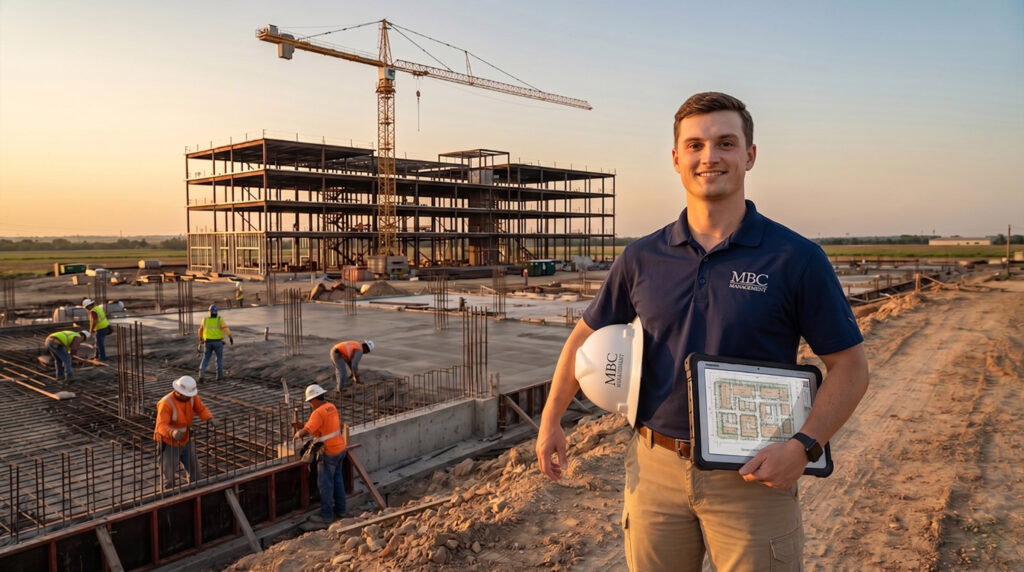
College Station doesn’t look like a construction boom from the outside. That’s precisely why developers who’ve been watching Brazos County are moving faster than they expected to. A $226 million semiconductor facility just broke ground. A $671 million highway overhaul is underway. Hundreds of millions in mixed-use development are stacking up across the city’s most active districts. This is a market backed by concrete, steel, and state investment — not speculation.
Key Takeaways
- College Station ranks among the fastest-growing metros in Texas, with commercial construction demand accelerating sharply into 2026
- Multiple large-scale projects are active or permitted across key development districts, including Northgate and the RELLIS corridor
- Infrastructure investment spanning transportation upgrades and utility expansion is keeping pace with population growth
- Texas A&M University’s institutional footprint drives direct and indirect construction demand that no comparable mid-size Texas market can replicate
- MBCM brings deep local knowledge of Brazos County permitting and city relationships, positioning the firm to deliver complex commercial projects in this market
A Texas Growth Story Centered on College Station
The Bryan-College Station metro ranks 65th nationally for percentage population growth, adding nearly 20,000 residents since 2020. That surge doesn’t happen by accident — it happens when multiple demand engines fire simultaneously.
Texas A&M University is the anchor. With one of the largest enrollments in the country and a research mandate that keeps expanding, the university generates a construction pipeline extending well beyond campus boundaries: workforce housing, medical facilities, retail corridors, research infrastructure.
The RELLIS Academic Alliance campus in Bryan deepens that footprint into applied research and advanced manufacturing, attracting a different class of tenant and a different class of project.
The state is reinforcing this momentum through semiconductor and advanced manufacturing investment, and the BCS corridor is a primary landing zone. Forbes has recognized College Station among America’s Next Boom Towns, citing economic strength, an educated talent pool, and quality of life metrics that attract employers.
The region’s GDP reached $15.8 billion in 2023 and has grown steadily since 2020. This is not a community riding a single trend — it is compounding multiple advantages at once.
What’s Driving the Commercial Construction Surge
The demand isn’t concentrated in one category. Multifamily mixed-use development is the most visible — high-rise residential with ground-floor commercial, particularly in the Northgate district adjacent to campus. But institutional and research construction is accelerating just as fast, driven by Texas A&M’s expanding research commitments and the RELLIS campus build-out.
Healthcare, retail, and hospitality construction is also expanding along key commercial corridors as the workforce grows and visitor traffic increases. The development pattern reflects a business community maturing around a world-class university — and that maturation creates opportunity across every construction segment.
Active Projects and Development Districts Shaping 2026
The pipeline isn’t theoretical. Named projects with committed capital are already underway.
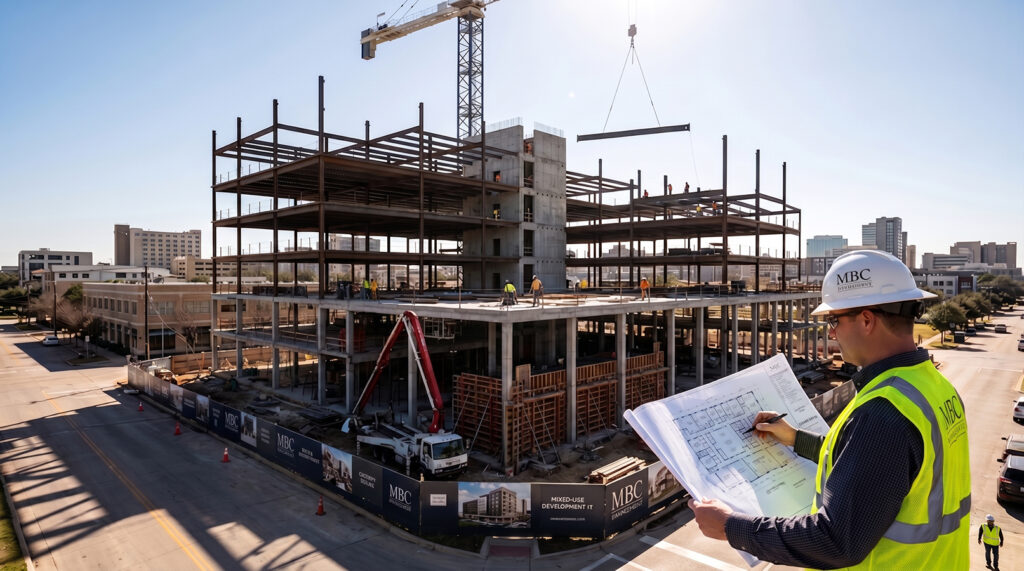
The Hub on Campus — a $129.97 million, 1.12 million-square-foot development featuring an eight-story residential building and a 10-story parking structure — broke ground in May 2026 and is scheduled for completion by June 2028. The Rambler Northgate, a $125 million mixed-use tower rising 24 stories with 342 for-rent residential units and ground-floor commercial space, is on the same delivery track. Both projects sit within Northgate, the most active commercial development zone in the city.
At RELLIS, Texas A&M broke ground on the Texas A&M Semiconductor Institute — an 80,000-square-foot research and collaboration center funded at $226 million — with Governor Abbott present at the April 2026 ceremony. That project signals something significant: College Station is no longer just a college town. It is becoming a technology and research construction market with national-caliber anchor institutions.
| Construction Segment | Demand Driver | Example District/Location | 2026 Outlook |
|---|---|---|---|
| Multifamily / Mixed-Use | Population growth, student housing | Northgate District | High |
| Institutional / Research | Texas A&M expansion, RELLIS campus | Innovation District | High |
| Healthcare / Medical | Texas A&M Health Science Center | Medical Corridor | Growing |
| Retail / Hospitality | Workforce and visitor growth | University Drive, Hwy 6 | Moderate–High |
| Infrastructure / Civil | City CIP, utility expansion | City-wide | Active |
The Infrastructure Investment Keeping Pace with Growth
A reasonable question from any developer evaluating this market: can the infrastructure actually support the growth?
In College Station, the answer is yes. The city is committed capital to prove it. The Big 6 transportation project represents a $671 million upgrade to State Highway 6 through the Bryan-College Station corridor, with 2026 focused on main-lane widening and drainage improvements. On the utility side, the city council voted unanimously to award a $28 million contract to drill three new water wells, directly addressing capacity constraints. The Wellborn Special Utility District’s 2026 Supply Expand Project adds further redundancy to the regional water system.
Conservation is part of this story too. Despite a 26% population increase since 2010, the region’s total water consumption has held roughly flat at approximately 4 billion gallons annually, thanks to the BVWaterSmart conservation program. City Council also approved a meaningful zoning update in March 2026, clearing the way for new construction and streamlining how large projects are reviewed. These are the signals serious investors look for before committing capital.
Why the Right Construction Partner Matters in This Market
Understanding a market thesis and executing a project within it are two different things. College Station has its own permitting rhythm, its own UDO (Unified Development Ordinance) zoning requirements, and established relationships between contractors, city inspectors, and project reviewers. An out-of-market firm learning Brazos County codes on your schedule and your budget is a risk that compounds quickly.
MBCM is built for this market. With established relationships across every phase of the local development process, MBCM brings the kind of community knowledge that directly reduces project risk — faster permitting, fewer inspection surprises, and a clear-eyed read on how construction activity in each active district affects timelines and logistics. The Northgate district in particular has shown what it costs when construction isn’t managed by people who know the terrain.
MBCM’s commercial capabilities cover the full range of active demand segments — multifamily, institutional, retail, and infrastructure-adjacent commercial. If you’re working through early-stage planning for a project in this market, reach out to MBCM directly at (936) 825-1603 to have that conversation before the pipeline gets tighter.
Conclusion
College Station’s commercial construction growth is a multi-driver market reality backed by institutional investment, state commitment, and a population base expanding faster than most Texas metros. With $226 million in research infrastructure, $671 million in transportation upgrades, and hundreds of millions in active mixed-use development already moving through 2026, the market is in its most consequential phase yet. If you’re evaluating a project here, the practical next step is a conversation with a contractor who knows this market from the inside. Contact MBCM to discuss what your project requires and what realistic timelines and budgets look like on the ground.
FAQ
Is College Station a good market for commercial construction investment in 2025 and 2026?
Yes. The market is anchored by Texas A&M University, supported by state-level economic investment in semiconductor and advanced manufacturing, and validated by hundreds of millions in active commercial development already underway heading into 2026. Early positioning in this Texas market still carries a meaningful cost advantage over saturated metros.
What types of commercial construction projects are most active in College Station right now?
The most active segments include multifamily mixed-use development in the Northgate district, institutional and research construction tied to Texas A&M’s expansion and the RELLIS campus, healthcare-adjacent commercial along the medical corridor, and infrastructure projects funded through the city’s Capital Improvement Program.
How does Texas A&M University affect the College Station construction market?
Texas A&M functions as both a direct construction client — through campus expansion, research facility development, and the new Semiconductor Institute — and an indirect market driver that anchors population growth, supports a year-round visitor economy, and attracts research-driven employers generating their own facility requirements.
What infrastructure upgrades is College Station making to support commercial growth?
The city awarded a $28 million utility contract to drill three new water wells, committed $671 million to expand State Highway 6 through 2030, and approved zoning updates that simplify development review. Conservation programs are keeping water demand in check even as the community continues to expand.
How does College Station compare to Austin or Houston for commercial construction?
College Station offers a lower land cost basis, less permitting congestion, and an institutional demand anchor that doesn’t erode in an economic downturn — advantages Austin and Houston lost years ago. Growth here is deliberate and infrastructure-backed, not the unchecked development that has created cost and timeline problems in larger Texas markets.
What should I look for in a commercial contractor in College Station, Texas?
Prioritize local permitting knowledge, UDO familiarity, and established relationships with Brazos County reviewers and city inspectors. A contractor who has delivered commercial projects in this specific community will move faster and encounter fewer surprises than an out-of-market firm. MBCM brings that track record alongside direct experience in the Bryan-College Station development environment. Start with a call to (936) 825-1603.