

Planning a commercial build in College Station means making financial decisions before you have the full picture — and that gap is where most budgets quietly fall apart. Most owners fixate on a single number: cost per square foot.
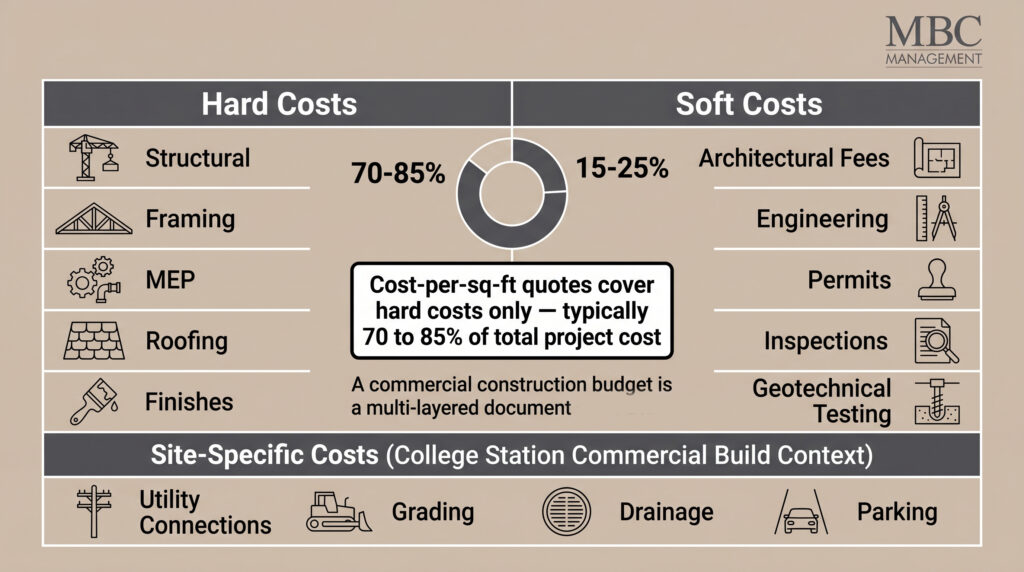
It’s concrete, it’s quotable, and it covers roughly 70 to 85 percent of what the project will actually cost. The rest arrives as a surprise.
At MBCM, we’ve guided commercial construction in College Station through every phase, and the pattern holds across project types: incomplete budgets create expensive problems. Here’s what those budgets consistently miss.
Key Takeaways
- The per-square-foot quote covers hard costs only — it is one line in a much larger commercial construction budget
- Soft costs (architecture, engineering, permits, inspections) typically add 15 to 25 percent on top of the construction contract number
- College Station permitting timelines are unpredictable — factor holding costs into the budget for every month of review
- Industry-standard contingency for a ground-up commercial build is 10 to 15 percent, not 3 to 5
- A pre-construction review with a local contractor is the highest-ROI step before financing is committed
What a Commercial Construction Budget Actually Includes
Most owners arrive with a construction cost estimate and treat it as their budget. It isn’t.
That number covers hard costs — structural work, framing, mechanical, electrical, plumbing, roofing, and finishes. Hard costs are real and significant. They’re also only 70 to 85 percent of total project cost. Everything else falls into soft costs, and that’s where commercial construction budgets quietly come apart.
Hard Costs vs. Soft Costs: The Split That Surprises Most Owners
Hard costs are what gets built. Soft costs are what makes building legally and professionally possible — architectural and engineering fees, civil surveys, permit applications, inspections, geotechnical testing, and lender-required documentation. None are optional, none can be deferred, and they’re funded before a shovel touches the ground.
Site-specific costs compound this further. Utility connection fees, grading, drainage infrastructure, and parking all carry real implications that don’t always appear in the base quote. A site selected for its land price alone may require utility extensions that add six figures to the total.
Building type changes the math dramatically. A warehouse carries a different cost profile than a medical office, and a retail strip center is not priced like a mixed-use commercial building. In the Brazos Valley, where healthcare has grown over 200 percent since 2000, owners in that sector need to budget well above state averages.
Average Commercial Construction Cost Per Square Foot in Texas
Texas commercial construction costs per square foot range broadly depending on building type, finish level, and market conditions. The table below reflects typical Texas ranges alongside College Station-specific context.
| Building Type | Typical Texas Range (per sq ft) | College Station Market Note |
|---|---|---|
| Retail / Strip Center | $150 – $250 | Higher subcontractor demand near A&M corridors |
| Medical Office | $250 – $400+ | Specialized systems drive costs above state average |
| Warehouse / Industrial | $80 – $160 | Site prep and utility costs frequently underestimated |
| Mixed-Use | $200 – $350 | Zoning complexity can add permit and design costs |
| Restaurant / Food Service | $250 – $425 | Health code and equipment requirements add significant cost |
These ranges reflect hard costs only. A complete construction budget layers soft costs, site work, contingency, and financing carry on top. National cost calculators don’t capture Brazos Valley pricing conditions — in an active development market, those tools can understate real costs by 20 percent or more.
The Local Variables That Make College Station Budgets Unpredictable
College Station sits in a secondary Texas market tier, which carries genuine pricing advantages — but only for owners who understand how this market actually behaves.
Permit timelines through the City of College Station’s Development Services Department are not standardized. Owners who plan for a four-week review have encountered three-to-four month processes during high-volume periods. Every month of delay has a real cost: construction loan interest accrues, land holding costs continue, and team fees don’t pause. A permit delay that felt like a scheduling inconvenience becomes a budget overrun fast.
Material pricing fluctuation is a live risk in active Texas construction markets. Assumptions made during pre-design may not hold through procurement, and owners who don’t account for this exposure often find their contingency absorbed before framing begins. Large-scale projects along the SH 6 corridor, the Century Square Phase II mixed-use development, and healthcare facility growth near campus are all competing for the same skilled subcontractors — and in that environment, bids routinely come in above estimates pulled from national databases.
Contingency Planning and Change Orders: The Budget Risk Nobody Plans For
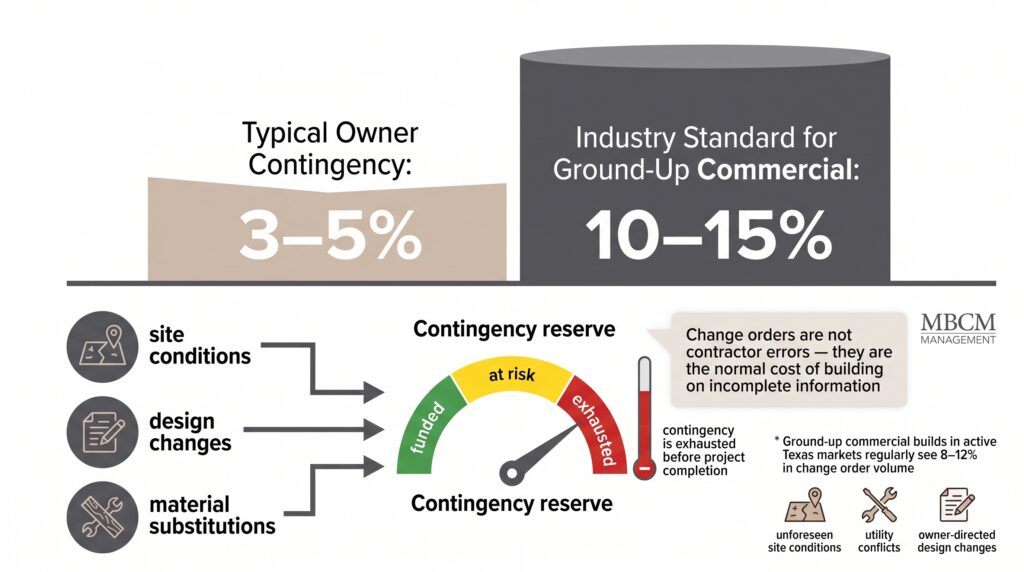
The industry standard contingency for a ground-up commercial construction project is 10 to 15 percent of total construction cost. For renovation and tenant improvement projects, 15 to 20 percent is more appropriate — unknown existing conditions guarantee surprises. Most first-time owners self-assign 3 to 5 percent. That number evaporates the moment subcontractor bids return above estimate.
Contingency is not a slush fund. It’s a structured reserve against specific risk categories: site condition discoveries, utility conflicts during excavation, material substitutions, and change orders generated by design evolution. Owners who undersize this reserve end up managing financial damage control at the 70 percent completion mark.
Change orders aren’t always the result of poor planning — site conditions and code interpretations generate scope changes that hit an already tight construction budget regardless. The best defense is a well-defined scope before design finalizes, not a 4 percent buffer and a hope that nothing surfaces.
Pre-Construction Planning: Where Smart Owners Start
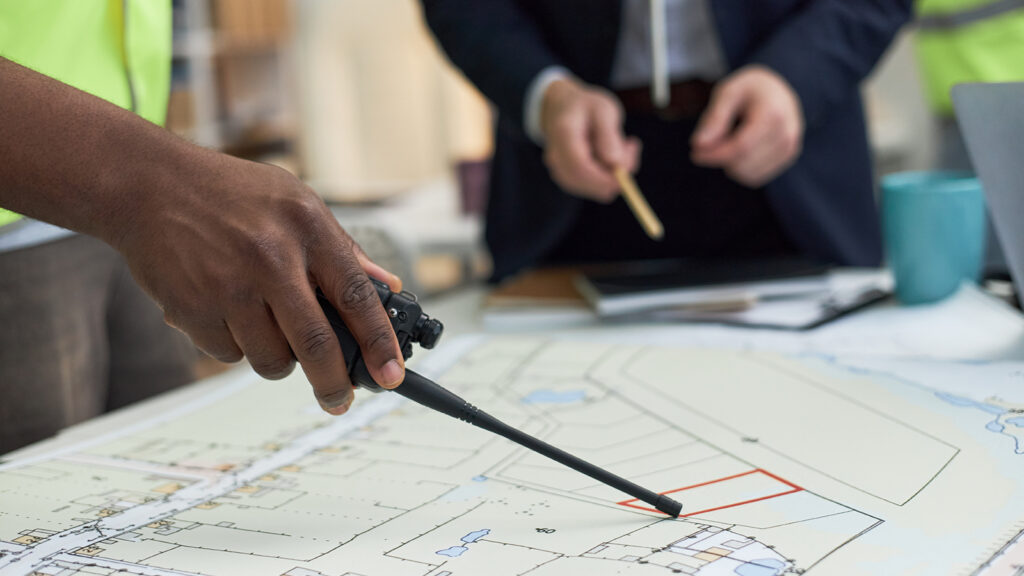
This is the phase where every risk in this article becomes manageable. A line-by-line construction budget developed with a local contractor — before design locks in, before financing commits — catches the gaps that generic calculators miss entirely.
Value engineering, the process of identifying cost-efficient alternatives that meet functional goals without sacrificing quality, works best here. Introduced mid-build under financial pressure, it doesn’t optimize the project — it compromises the finished asset.
A local contractor with active permit history in Brazos County and current subcontractor relationships brings pricing that reflects what bids are actually returning in this market right now, not what a national database recorded last year. That distinction is what separates a construction budget that holds from one that doesn’t.
Build Smarter Before You Commit
The construction quote is not the budget. In a market moving as fast as College Station, the gap between those two numbers is where commercial construction projects fail — not during framing, but in the planning phase, before anyone asked the right questions.
MBCM offers a free pre-construction consultation for commercial owners in College Station and the Brazos Valley. It’s a direct conversation about your project scope, realistic local cost ranges, and the specific line items your current numbers are most likely missing. Reach out to MBCM before design finalizes or financing closes.
FAQ
What is the average commercial construction cost per square foot in College Station, Texas?
Texas commercial construction costs range from roughly $80 to $425 per square foot depending on building type and finish level. College Station trends above state average in retail and medical categories due to tightened subcontractor capacity from A&M-driven development activity. Any per-square-foot figure used in financing or planning decisions should be validated with a local contractor who has current Brazos Valley pricing, not pulled from a national aggregator.
What soft costs do most commercial owners forget to budget for?
The most commonly overlooked soft costs are architectural and civil engineering fees, permit application and review fees, land surveys, geotechnical testing, third-party inspections, and lender documentation requirements. These items typically add 15 to 25 percent to the construction contract number and must be funded before construction begins.
How long does commercial permitting take in College Station?
Timelines vary based on project type and development volume. Owners who plan for a four-week review have encountered three-to-four month processes during busy periods. Budget the timeline conservatively and factor holding costs into the construction budget for every month of permit review, including construction loan interest and land carrying expenses.
How much contingency should I include in a commercial construction budget?
The industry standard for a ground-up commercial build is 10 to 15 percent of total construction cost. For renovation or tenant improvement construction projects, 15 to 20 percent is appropriate due to unknown existing conditions. Contingency should be structured against identified risk categories, not carried as a vague buffer.
Why don’t national construction cost calculators work for College Station?
National calculators pull data from across markets and don’t reflect local subcontractor pricing, permit fee structures, or site-specific conditions. In the Brazos Valley, where active development has constrained subcontractor availability, national estimates can understate actual costs by 20 percent or more before design is even finalized.
What is value engineering and when should it happen?
Value engineering is the process of identifying cost-efficient alternatives that meet a project’s functional and design goals without compromising quality or long-term asset value. It works best during pre-construction, before the design is finalized. Value engineering decisions made under financial pressure mid-build typically result in compromises that reduce the finished asset’s value.
When should I involve a commercial contractor in the budgeting process?
Before design is finalized and before financing is committed. A pre-construction review — not after bids are returned, but before budget assumptions are locked in — is the step that separates projects that finish on budget from those that spend the final phase in financial damage control. A contractor with local permit experience and active Brazos Valley subcontractor relationships provides budget validation no calculator can replicate.