
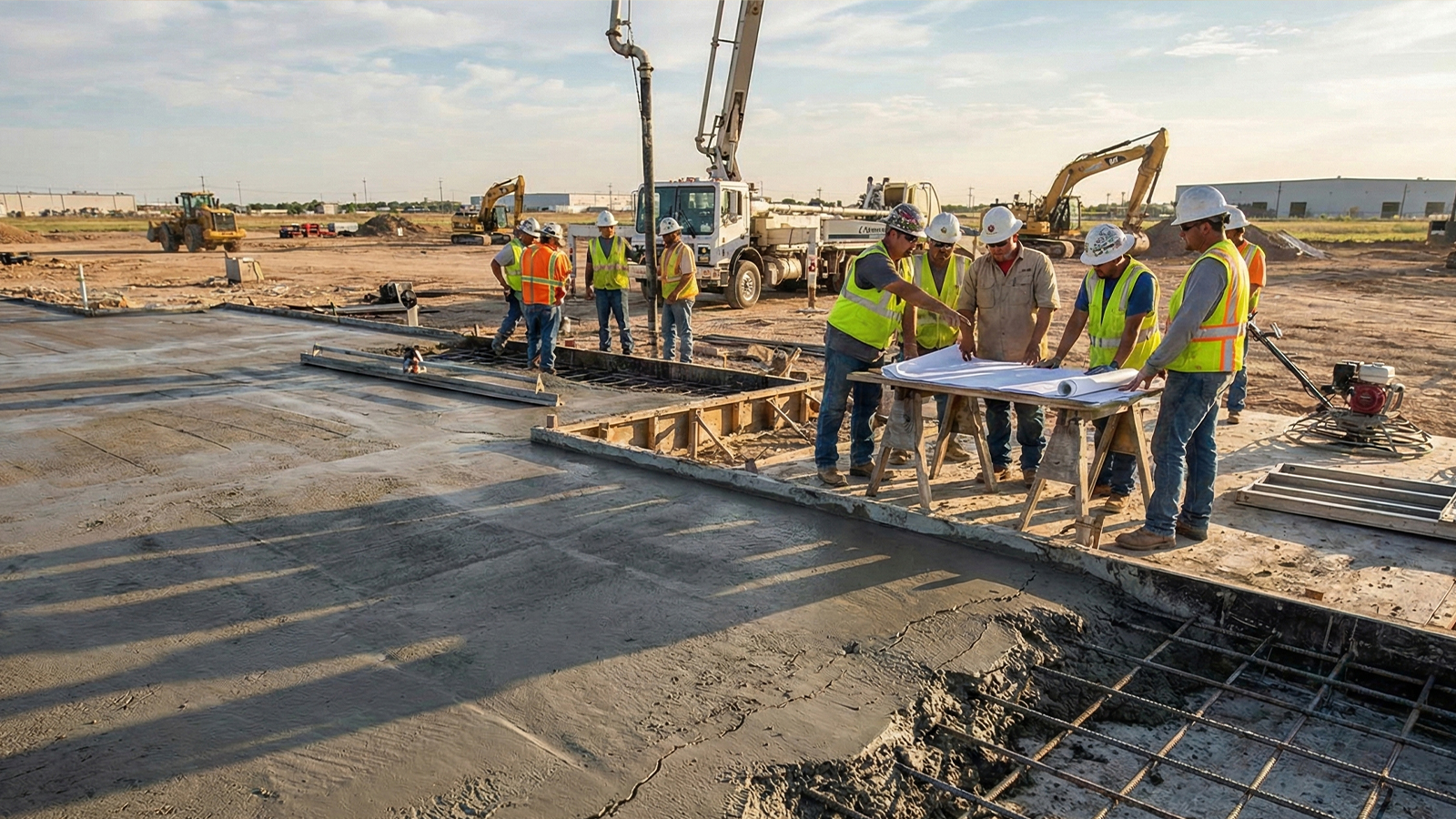
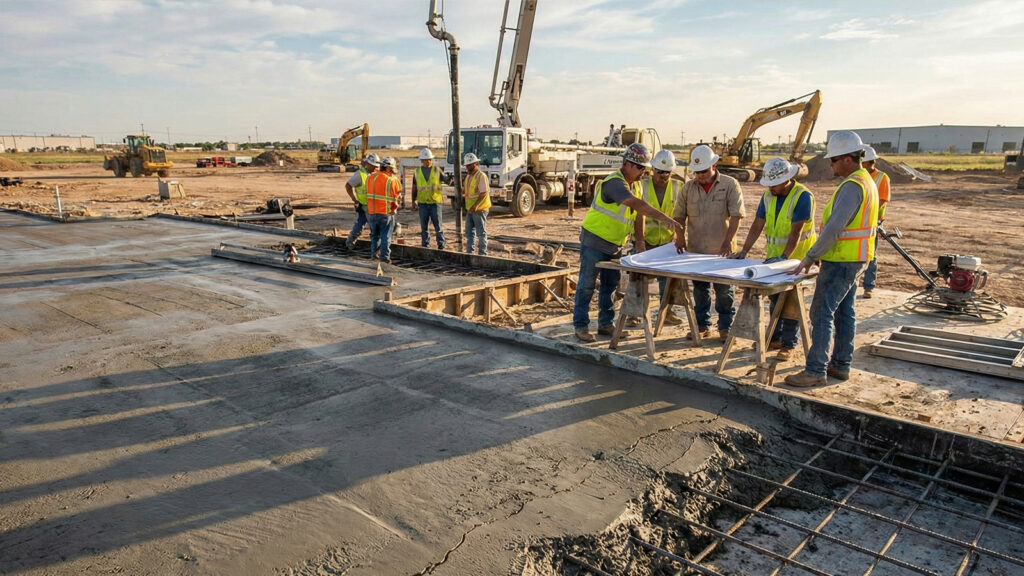
Commercial concrete is key in modern construction across Texas. It’s used in retail centers and warehouses. These structures must last for decades, needing careful planning and precise execution.
Making mistakes in commercial construction can be costly. A single error can lead to expensive repairs, delays, and safety risks. At MBCM, we’ve seen how even minor oversights can compromise structural integrity and harm more than just the project timeline.
Concrete placement needs specific depths for different loads. Loading docks need 10 to 12 inches for heavy trucks. Commercial driveways require 8 to 10 inches for daily use. These depths are not just suggestions but are critical for the structure’s strength.
The installation process involves several important steps. Teams must calculate the right mix, prepare the site, and watch the weather. Each step can lead to mistakes that weaken the structure. Smart planning helps contractors avoid these issues and create lasting projects.
Key Takeaways
- Commercial concrete requires 10-12 inches depth for loading docks and 8-10 inches for driveways
- Proper mix design directly impacts the strength and durability of commercial structures
- Weather conditions play a critical role in successful concrete placement and curing
- Site preparation mistakes can cause structural failures years after installation
- Meeting building codes requires attention to every detail of the placement process
- Professional contractors prevent delays by following established best practices
Understanding the Fundamentals of Commercial Concrete Placement
Mastering the basics is key to long-lasting success in concrete projects. Professional placement focuses on three main areas: the right mix design, adapting to weather, and having the right equipment. These basics can ensure a durable structure or lead to costly repairs.
The Importance of Proper Mix Design for Commercial Projects
The right mix design is vital for a project’s strength and durability. There are five main types of concrete for commercial use. Type I is for general projects, while Type II resists moderate sulfate exposure. Type III is for quick projects, Type IV for large pours, and Type V for severe sulfate conditions.
Your concrete supplier can guide you through seven admixture categories. These enhance specific properties like setting time, freeze-thaw resistance, and corrosion protection.
- Accelerating additives speed up setting time
- Air entrainment improves freeze-thaw resistance
- Corrosion inhibitors protect embedded steel
- Retarding additives slow setting in hot weather
- Shrinkage reducers minimize cracking
- Superplasticizers increase workability
- Water reducers maintain strength with less water
Using the wrong concrete mix is a common mistake. Each admixture has a specific role, and the wrong mix can weaken your structure.
How Weather Conditions Affect Concrete Installation
Weather is critical in the first 24 to 48 hours after pouring. Cold weather requires insulation or heated enclosures to prevent freezing. Hot weather demands frequent misting or coverings to prevent moisture loss.
Good weather for concrete work includes three days without rain and temperatures between 50°F and 75°F. Planning for favorable weather ensures proper curing and avoids common mistakes.
Essential Tools and Equipment for Professional Concrete Work
Having the right tools before starting is essential. You’ll need industrial wheelbarrows, trowels, and screeds. A darby smooths large areas, and bull floats create the initial finish. Hand floats refine edges, and concrete rakes distribute material evenly.
Safety gear is also critical. Ensure all tools are ready before the concrete supplier arrives. Rushing can lead to poor results and compromised quality.
Site Preparation Errors That Compromise Structural Integrity
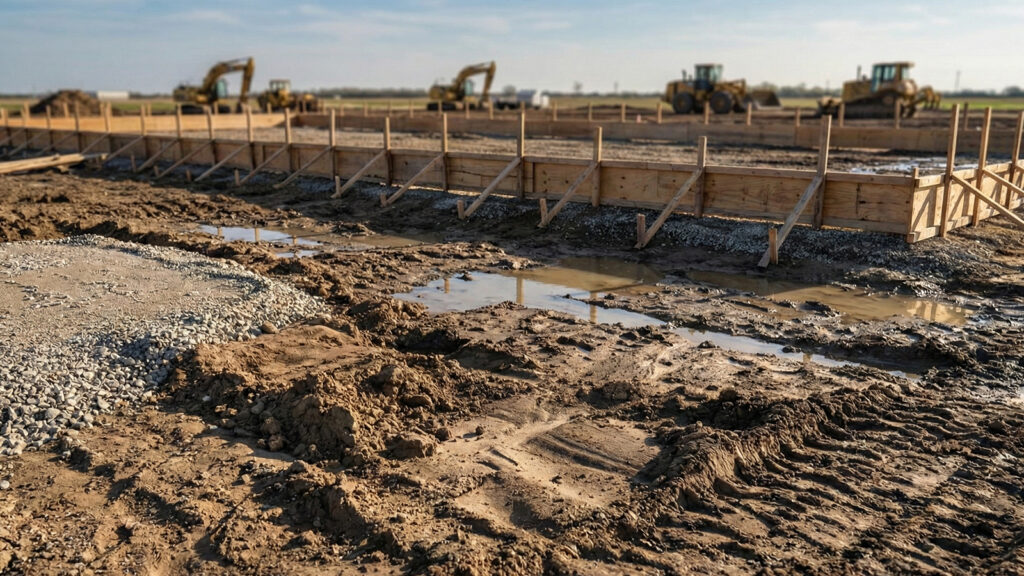
Poor site preparation is a big mistake in commercial projects. Contractors who rush the groundwork face big problems. These issues can cause settling, cracking, and failure of the concrete in just a few years.
Inadequate Subgrade Compaction and Its Consequences
The subgrade is the base of your concrete slab. If it’s not compacted right, it’s weak and settles unevenly. Pros aim for 95% Modified Proctor Density in the subgrade. This means removing soft soil, roots, and organic stuff first.
A good base has 4 to 6 inches of crushed stone. This spreads weight evenly. Without proper compaction, slabs crack and dip. These problems show up months later, making repairs costly and disruptive.
Failure to Address Drainage Issues Before Pouring
Water under concrete causes swelling that harms the structure. Proper drainage channels keep water away. A gravel base lets water flow, preventing moisture buildup and cracking.
Overlooking the Need for Proper Formwork Support
Forms shape wet concrete and must handle pressure. Weak or poorly braced forms bow, making surfaces uneven. Tight joints and bracing every few feet are key. Control and expansion joints are placed at 24 to 36 times the slab thickness to avoid random cracks.
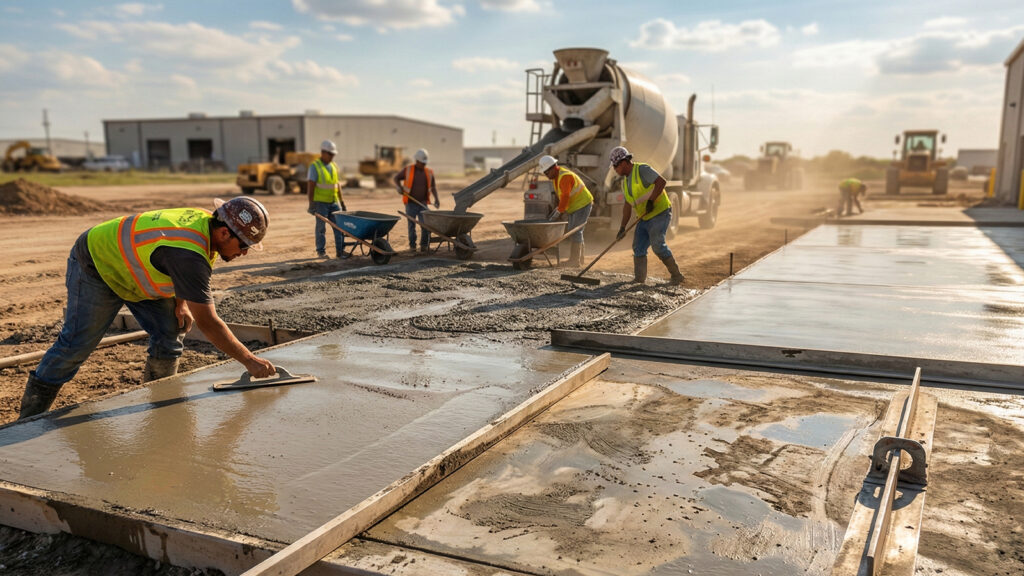
Mistakes in Concrete Mix and Water-Cement Ratio
Getting the water-cement ratio right is key for strong concrete. Adding too much water is a big mistake in commercial projects. Too much water makes the concrete weak and lowers its strength by up to 40 percent.
The usual water-cement ratio is 0.50 for most jobs. But, for structural parts, it should be 0.45 or less. Adding water at the site to make it easier to pour weakens the structure. This leads to more cracks as the concrete cures.
| Water-Cement Ratio | Compressive Strength (psi) | Best Use |
|---|---|---|
| 0.40 | 5,600 | High-strength structural elements |
| 0.45 | 4,900 | Standard structural concrete |
| 0.50 | 4,200 | General construction |
| 0.60 | 3,000 | Non-structural applications |
Using too little water also causes problems. The concrete becomes hard to spread and won’t set right. Instead, use plasticizers or superplasticizers to improve workability without losing strength. Avoid overworking stiff mixes to prevent weak spots. Plan well to avoid using too much concrete and meet ACI 211.1 standards.
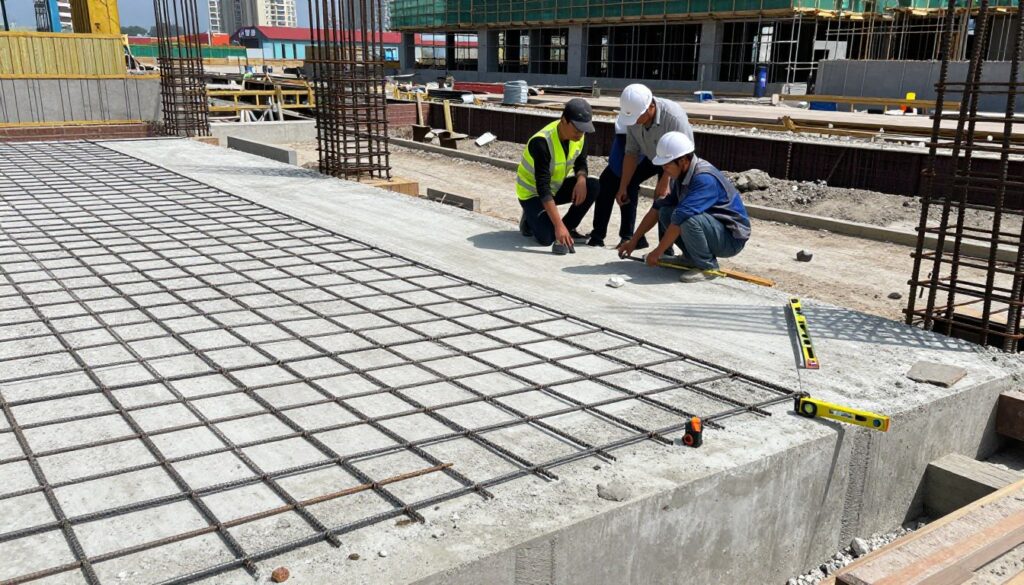
Improper Reinforcement Placement and Steel Mesh Installation
Reinforcement is key to stopping cracks and keeping concrete structures strong. If steel mesh or rebar is too close to the surface or at the bottom, it can’t handle loads well. This mistake can cause damage and cost a lot to fix.
Common Errors in Rebar Positioning and Coverage
Contractors often make mistakes with where they put the steel bars. The right amount of concrete cover depends on where the structure is:
- Interior slabs: 1.5 inches minimum cover
- Exterior concrete surface: 2 inches minimum cover
- Foundations in direct soil contact: 3 inches minimum cover
Steel too close to the surface gets wet and rusty. This rust can make the concrete crack and cost a lot to fix.
Why Steel Mesh Must Be Centered in the Concrete Slab
Steel mesh must be in the middle of the slab to work right. First, pour half the concrete, then add the reinforcement, and finish with the rest of the concrete. This way, the mesh settles in the best spot.
The Impact of Neglecting Proper Spacers and Chairs
Spacers keep the steel in place as the concrete is poured. Without them, the steel can sag or move. Concrete needs careful placement of reinforcement to work well in buildings and roads.
Critical Errors During the Pouring and Finishing Process
Timing is key when pouring concrete. Professional contractors like MBCM know that mistakes in the early stages can cause lasting problems. They must work quickly and correctly to avoid issues.
One major mistake is trying to pour concrete alone. Concrete work needs a team. It should be placed as close as possible to its final spot. Moving it too far weakens the concrete.
After pouring, level the surface right away with a screed board. Use a darby or bull float to remove air pockets. Many make the mistake of starting to finish too soon.
Starting too early traps moisture, causing scaling and deterioration. It’s important to wait for bleed water to evaporate before finishing.
Overworking the concrete is another big mistake. Too much floating can make the top weak and prone to cracking. The best time to work the concrete is when bleed water has gone but before it sets.
For safety, walkways and driveways need texture. Use a concrete broom at a 90-degree angle to add traction. Decorative techniques like stamping should wait until all moisture is gone. A good contractor avoids common mistakes to ensure safety.
Curing Mistakes That Lead to Premature Cracking and Failure
Curing is key to making concrete strong. Small errors can make it weak and cause cracks early. Not curing right can cut concrete strength by half and damage its surface.
The Dangers of Removing Forms Too Soon
Forms help concrete get strong. Taking them off too early can cause cracks and collapse. The American Concrete Institute says wait at least 48 hours, depending on the cement type.
How Improper Curing Affects Long-Term Durability
Bad curing makes concrete weak and prone to cracks. Not replacing moisture leads to early damage. Good curing keeps it warm and moist for lasting strength.
Best Practices for Curing in Extreme Weather Conditions
Extreme weather needs special care. Hot weather means quick moisture application. Cold weather needs insulation to keep it warm.
Using Curing Compounds vs. Traditional Wet Curing Methods
Chemical compounds keep moisture in, while wet curing adds water. Both prevent cracks if done right. The choice depends on the project and weather.
Conclusion: Ensuring Success in Your Commercial Concrete Projects with MBCM
Commercial concrete work needs precision at every step to avoid costly errors. From choosing the right mix to the 28-day curing process, each step is critical. MBCM offers specialized knowledge in the College Station and Brenham areas of Texas. They help clients through these important phases with confidence.
Common mistakes in commercial concrete work include bad subgrade prep and early form removal. Getting the water-cement ratio right, placing reinforcement correctly, and using the right curing methods are key. MBCM follows American Concrete Institute standards to avoid common problems like overworked surfaces and poor formwork support.
Choosing a professional contractor like MBCM ensures your concrete meets strength and building code standards. Our experience in Texas helps clients avoid expensive repairs and structural failures. We use weather monitoring, the right tools, and proven techniques to create durable concrete structures.
FAQ
What is the most common mistake when mixing concrete for commercial projects?
The biggest concrete mistake to avoid is using too much water to make the mix easier to work with. This can cut the concrete’s strength by up to 40% and cause it to crack early. The right mix ratio is 0.50, as per Uniform Building Codes. For structural parts, it should be 0.45 or less. Instead of adding more water, use plasticizers or superplasticizers to get the right consistency.
Why do cracks in concrete appear shortly after installation?
Cracks often come from bad curing, overworking the concrete, or not using control joints. If bleed water dries out too fast, without being replaced, it causes surface defects and early cracking. Control joints should be cut within 6-12 hours of placing the concrete to prevent random cracks.
How does improper reinforcement placement affect a concrete slab?
Wrong placement of reinforcement can lead to steel corrosion, loss of structural integrity, and poor load transfer. Steel mesh should be in the center of the concrete, not too close to the surface or bottom. Use plastic or concrete spacers to keep it in place. Not enough coverage is a common mistake that affects the slab’s load-bearing ability and expansion and contraction.
What is the proper curing process for commercial concrete?
Proper curing keeps temperatures above 50°F and prevents water loss from the surface for at least 7 days. Use continuous wet curing, moisture-retaining coverings, or chemical curing compounds. Bad curing can reduce strength by up to 50% in 7 days. Full strength is reached in 28 days, but 7 days is the minimum for most commercial projects.
Should I hire a professional contractor for commercial concrete projects?
Yes, hiring a professional like MBCM ensures the right mix, site prep, reinforcement, and curing. They know the building codes, have the right tools, and avoid costly mistakes that could harm safety and durability.
What are the different types of concrete admixtures and when should they be used?
There are seven types of admixtures: those that speed up setting, improve freeze-thaw resistance, protect steel, slow down setting in hot weather, reduce shrinkage, improve workability, and reduce water content. Your supplier can suggest the right one based on your project’s needs.
How thick should a commercial concrete slab be for different applications?
Thickness varies with load-bearing needs. Loading docks need 10-12 inches, driveways 8-10 inches, and standard slabs depend on use. Too thin is a mistake that can cause early failure. A professional can help determine the right thickness for your project.